

Influencing a culture shift through leadership training at B. Braun
October 8, 2026
Great managers know how to successfully delegate, because it’s an important way to get things done, freeing them up to focus on higher-priority tasks.
The evidence confirms delegation is a critical skill – a Gallup study of 143 CEOs of large US companies showed that the companies led by CEOs good at delegation posted an average three-year growth rate of 1,751% – 112 percentage points higher than companies led by CEOs with low or limited ability to delegate.
A further study by leadership consultancy DDI revealed effective delegation is a top factor in preventing burnout. Delegation isn’t only good for leaders. Giving team members the chance to work on tasks can also be an opportunity to help them, build on skills and improve confidence.
Despite it being critical to a team’s effectiveness, delegation is something many managers struggle with. And good delegation goes beyond just asking someone to do a task and giving them a deadline
Here’s our guide to successful delegation, including how to know you’ve been successful in doing it.
Cube’s five-point star model of successful delegation
When delivering training for new managers, we use a five-step model to explain successful delegation, represented by this star.
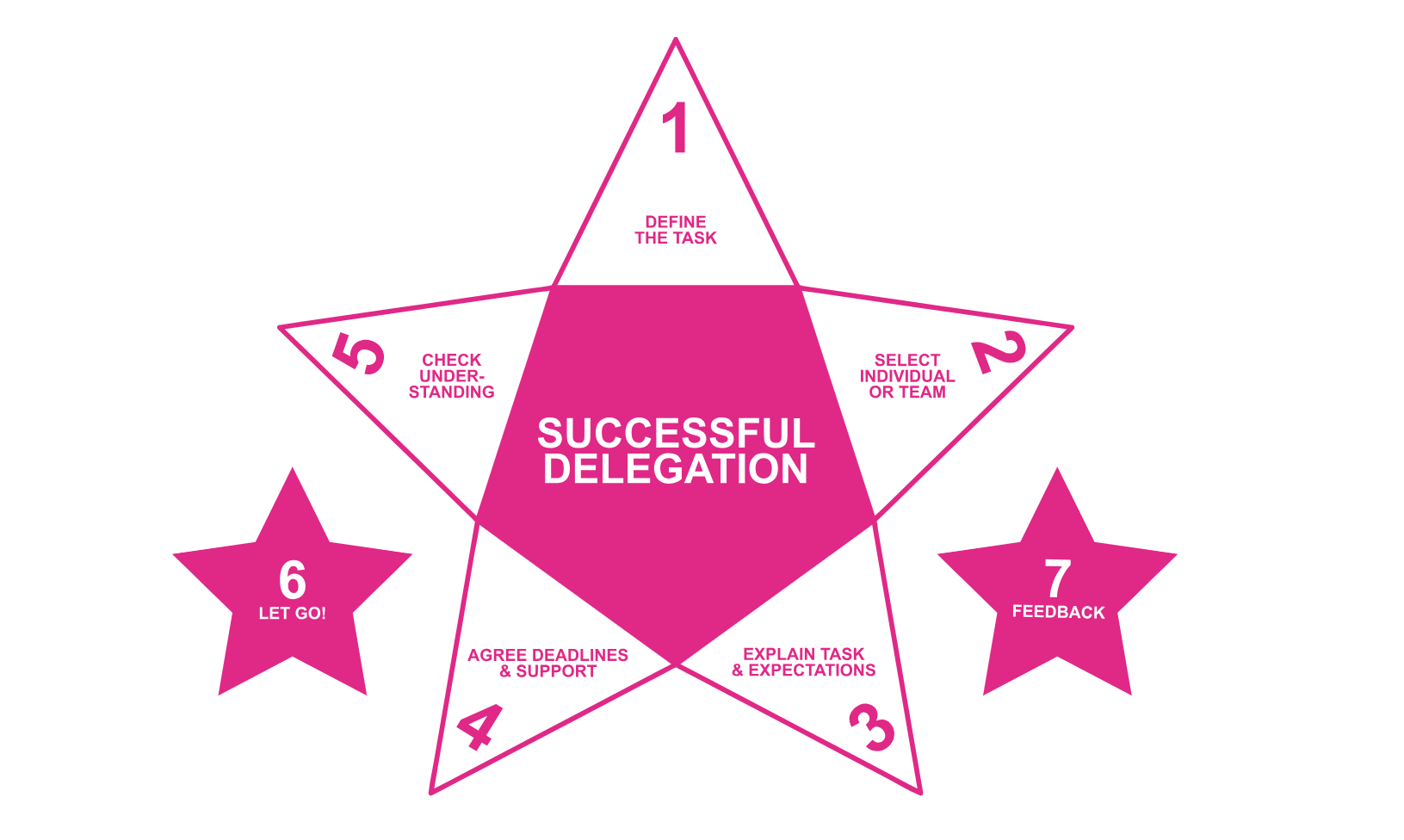
- Define the task
Asking a person to do something for you doesn’t start with the request. It starts with you having a clear understanding of the task you’ll be passing on. You need to assess the urgency and importance of the task, the deadline, how long it could take to complete, and who has the skills to complete is successfully. Having this clarity and context will help you to make the right decisions and will help you provide a good brief and avoid issues further down the line.
2. Choose the team or person who will deliver
Once you’re clear on the parameters of the task, you’ll be able to choose the most suitable person or team to deliver it. You’ll need to take time to consider the timelines involved and existing workloads, as well as who has the skills, confidence and authority to be successful, evaluating what will be the right choice. Additionally, you might decide the task could be a development opportunity for someone, perhaps because it’s not critical and there’s plenty of time
3. Explain the task you’re delegating, and your expectations
Notice this is step three of the process, not step one. But it’s definitely the crucial one and has the potential to substantially impact whether or not you have successfully delegated.
You need to clearly explain the task and your expectations of timeline and what success looks like to the person or team you’ve giving it to. Everyone involved needs to end up with a shared view of the task and success factors for delegation to be successful – and we find this is where the process often comes unstuck.
The detail you give at this stage will depend on who you’re delegating to and their level of skill or competence. You’ll need to give more guidance to someone less skilled but can rely on a baseline of knowledge from someone who has done the task before. Regardless of their existing competency, a shared understanding is what’s important here to ensure you both agree what the outcome needs to be
4. Agree deadlines and any support
Next, you’ll need to agree a deadline for the task you’re delegating. We’ve consciously used ‘agree’ not ‘tell’ here, because this step involves discussing the deadline with the team or person you’re delegating to and agreeing a suitable timeframe bearing in mind the urgency or importance of what you’re handing over and their existing workload and priorities.
In addition to agreeing a deadline, exploring whether the person or team needs any support to complete the task is important. Talk about how you will both/all communicate progress of the task, when or if you’ll check in during delivery, and what they should do if they struggle or hit problems. This is important so you don’t fall into the trap of a micromanager constantly checking and following up before you agreed you would and vice versa, so you don’t start to worry and lose confidence that they are making the required progress. Agreeing the support and communication at this stage sets out the terms for the relationship to be successful.
5. Check understanding
Often overlooked, this important final step gives you assurance that you truly have a shared understanding of what’s being delegated and when it will be delivered. This step is the best way to check you have delegated effectively and gives you the confidence that the team/person delivering has fully understood what they need to do. To check, you’ll need to ask open questions. (If you ask a closed question like, “Is that all okay?” or “Do you understand?”, you’re likely to get a positive answer, but that doesn’t really confirm you’re on the same page.)
Ask open questions like:
- How will you go about the task?
- When will you complete it by?
- How will we stay in touch about progress?
- How confident do you feel about doing the task?
- What will you do if you need support?
You’ll get more narrative answers that will help you figure out if there’s a mismatch between what you’re expecting and what the person thinks they are doing.
Trust the delegation process and let go
All you have to do at this point is let your colleague(s) get on with the task you’ve given them. This is the hard part – this is where you truly have to let go and empower the individual/team to get on with it.
If you’ve followed our five-step delegation process, you should feel comfortable that you’ll get the outcome you need. You mustn’t undermine people by micro-managing them at this stage, as this erodes trust. People want to feel you have confidence they can deliver. If you’ve delegated well, they should be able to do the task or ask for the help they need.
After the task is complete, you have an opportunity to give helpful feedback on the results. This way you are building trust in the person/team, and they are getting a good understanding of where/how they met your expectations. Use the BIFF model to keep your feedback helpful and constructive.